
Positioned within the thriving economic corridor of Laguna, the Calamba Commercial Center emerges as a purposeful articulation of streamlined retail design, responding to the region’s dynamic growth and increasing demand for mixed-use developments. Occupying a site area of approximately 5,957 square meters, the development asserts a deliberate geometry that capitalizes on the site’s wide frontage and irregular boundaries. The composition transforms the parcel into a multi-layered commercial destination that accommodates both vehicular and pedestrian activity, integrating diverse retail experiences and essential fueling services within a cohesive architectural framework.
Project Name: Calamba Commercial Complex
Location: Calamba City, Laguna
Site Area: 5,597 sqm
Type: Commercial
The architectural strategy revolves around the discipline of streamlined retail design. Instead of succumbing to the clutter often seen in multi-tenant complexes, the composition applies a disciplined rectilinear massing, centrally positioned within the site to maximize openness and visibility. This allows an intuitive flow for both vehicle circulation and pedestrian navigation across the entire property. With a unified plan that brings clarity to leasing parcels, tenants benefit from high visibility, direct accessibility, and balanced exposure throughout the property.
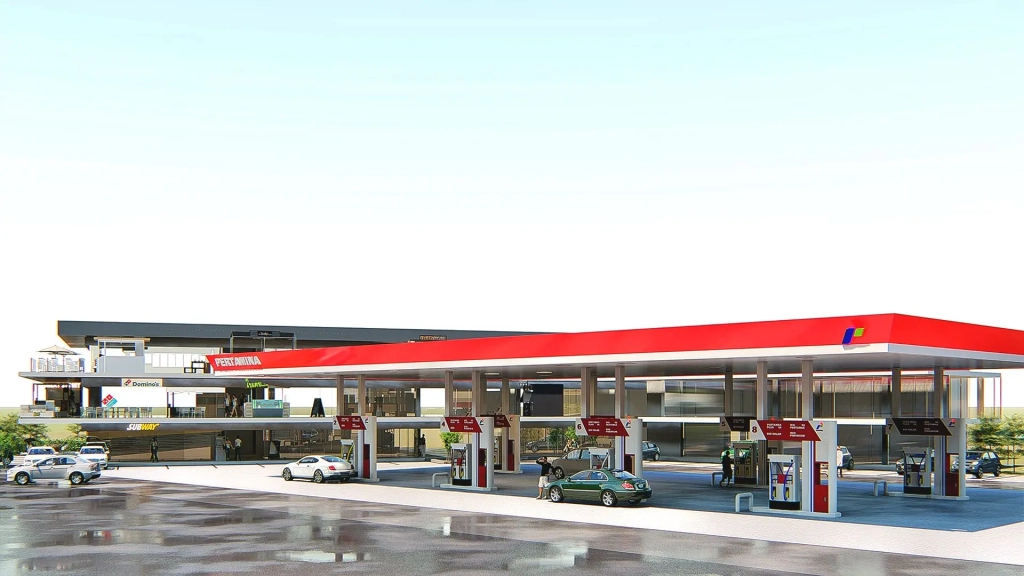
Anchoring the project is a distinct three-story commercial complex that rises prominently at the center of the site, floating with wide setbacks that create generous forecourts and circulation zones. The structure’s strong horizontal articulation is expressed through expansive terraces, cantilevered floor plates, and minimalist slab projections. Wide driveways, ample parking bays, and open-air walkways frame the perimeter, allowing for unimpeded vehicular and pedestrian movement. Transparent glass facades establish continuous visibility across all levels, showcasing merchandise, dining activities, and tenant branding to both ground-level patrons and passing vehicles. Elevated dining decks and rooftop terraces further enhance the lifestyle offering, transforming upper floors into destination experiences within the streamlined retail design framework.
A dedicated gasoline station is strategically positioned adjacent to the commercial structure, serving as a complementary activation point. Rather than existing as a separate facility, its proximity draws vehicular traffic that organically feeds into the retail circulation, enhancing cross-traffic between fueling, shopping, and dining activities. This adjacency strengthens the site’s commercial ecosystem, establishing the property as a complete roadside and neighborhood destination.

A key consideration in the streamlined retail design of Calamba Commercial Center is its allocation of twenty-two leasable spaces. These units support a diverse tenancy profile ranging from fashion boutiques to cafes, casual dining, and essential service providers. This tenant mix reflects modern consumer patterns where dining, daily essentials, and lifestyle services command more substantial foot traffic than traditional anchor-dependent models.
Circulation design emphasizes openness without sacrificing organization. Multiple vehicular entry points eliminate the need for complicated traffic loops. Wide circulation aisles and clearly designated parking bays accommodate both private cars and delivery access. Pedestrian movement is guided by covered walkways that maintain comfort under varying weather conditions, enhancing dwell time and encouraging exploration across the site.
Architecturally, the center’s minimalist aesthetic resonates with the discipline of streamlined retail design. The facades display a deliberate avoidance of ornamentation, focusing instead on proportion, material honesty, and functional expression. The use of glass, neutral cladding, and subtle steel detailing contributes to a contemporary commercial identity that is sophisticated yet inviting.
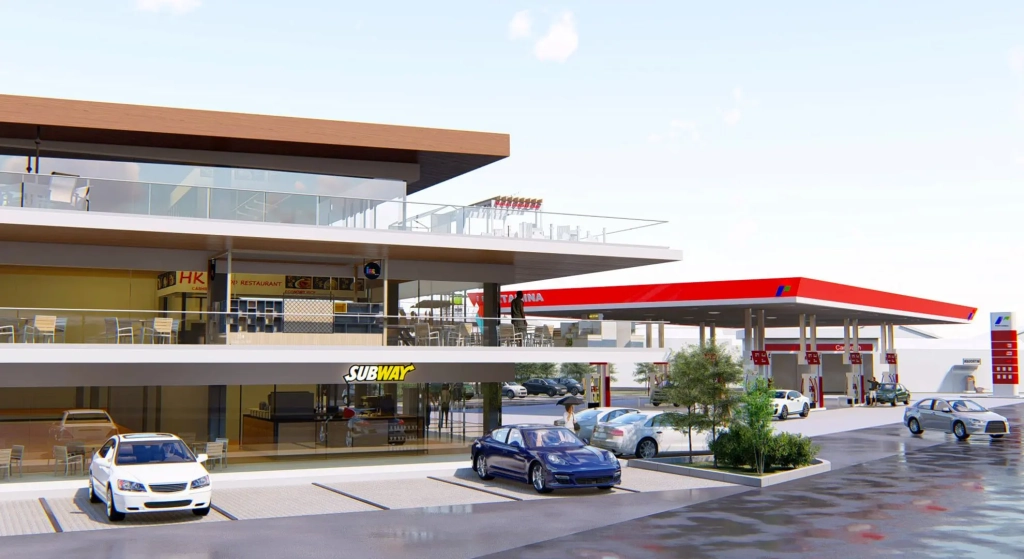
The master planning and design logic applied to Calamba Commercial Center represents an evolved approach to suburban commercial development. In an urbanizing node where real estate pressures demand both density and function, streamlined retail design provides the optimal response, balancing simplicity, commercial viability, and operational ease. This design vocabulary enables long-term adaptability, ensuring the property can maintain its relevance as tenant profiles evolve and consumer behaviors change.
Upon its completion, the commercial center embodies the core principle that streamlined retail design is not merely an aesthetic choice but a strategic business approach. The clarity of form, efficiency of circulation, seamless integration of the gas station, and versatility of tenancy all contribute to a development that serves as both an investment instrument and a community anchor in the growing landscape of Laguna.