Project Tag: Hub

  • Loop Top Commercial Mall

    Loop Top Commercial Mall

    Situated on a prominent 2,412-square-meter corner lot in Sta. Rosa, Laguna, Loop Top Commercial Mall initiates a thoughtful architectural exploration into how urban commercial forms can transcend prevailing conventions. The design orchestrates a synthesis between built structures, cultivated landscape, and curated pedestrian experience, composing a continuous architectural language that engages both spatial function and environmental responsiveness.

    At its core, Loop Top applies the principle of a unified built envelope organized around a rectangular loop that creates both clarity and flow. The circulation strategy avoids rigid compartmentalization by establishing fluid transitions between interior retail spaces, the central courtyard, and the external environment. In doing so, it fosters an immersive commercial experience that allows visual, spatial, and climatic interactivity throughout the site.

    A view of Loop Top Commercial Mall’s central courtyard showing multi-level retail spaces encircling a landscaped atrium with planted greenery, full-height glass storefronts, continuous walkways, open skylight above, and integrated architectural overhangs enhancing light and ventilation.
    The expansive courtyard functions as the organizational nucleus of the mall, orchestrating the interplay of light, air, and circulation throughout the surrounding spaces. Its open-air configuration introduces vertical permeability, allowing daylight to penetrate deep into the interior zones while promoting natural ventilation across multiple levels. This spatial openness enhances both the aesthetic and environmental performance of the architecture, creating an inviting atmosphere where interior spaces remain visually connected to the landscaped elements and the sky above.

    Project Name: Loop Top
    Location: Sta. Rosa, Laguna, Philippines 
    Site Area: 2,412 sqm 
    Project Area: 6,270 sqm 
    Type: Commercial

    The central courtyard serves as a central organizing void that simultaneously fulfills programmatic and environmental purposes. It invites daylight deep into the plan, facilitates passive ventilation, and offers an open-air spatial anchor that enhances both wayfinding and gathering. The configuration of shops, cafés, restaurants, and service functions wraps around this courtyard, maximizing visibility and access for each commercial tenant while preserving a sense of openness throughout the building.

    The primary feature of the design is its living roof system. The green roof extends across the entire upper plane, forming a continuous sloping landscape that functions not merely as a visual garnish but as a performative architectural element. The planted roof surface enhances thermal regulation, manages rainwater through passive collection strategies, and serves as a multi-functional outdoor amenity for visitors and building occupants. This elevated green space reclaims the open area displaced by the building footprint, allowing for recreational and social activities while restoring ecological continuity.

    An interior view of Loop Top Commercial Mall showing angled atrium openings framing the sloping green roof, upper-level glass balustrades, black stone flooring, multiple retail levels, and landscaped greenery merging interior circulation with sustainable design elements.
    Expansive views of the living roof create a seamless connection between the interior and natural landscape, enhancing the architectural harmony of the space. These elevated vistas enrich the spatial experience by integrating greenery into the occupant’s visual field, while also reinforcing the sustainability objectives embedded within the design. The carefully angled roof surfaces work in concert with natural light and vegetation to soften the built environment, blurring the boundary between architecture and its ecological context.

    Programmatically, the three-level structure accommodates a mix of commercial tenants tailored for flexible occupancy. Banking institutions, lifestyle brands, specialty cafés, and restaurants form the primary retail anchors, responding to both local and transient consumer behaviors. The spatial composition accommodates future adaptability, allowing for the reconfiguration of spaces to suit evolving tenant demands while preserving the integrity of the circulation network.

    A rooftop view of Loop Top Commercial Mall showing sloping green roof terraces with planted grass bands, sculptural white seating elements, hardscape walkways, native vegetation, panoramic city views, and adjacent upper-level retail frontage.
    The expansive green roof of the Loop Top serves as a dynamic living system, enhancing the mall’s aesthetic appeal while also contributing to urban biodiversity. The gently sloping green plane integrates native vegetation and adaptive plant species, creating a sustainable microhabitat within the urban context. This elevated garden promotes ecological continuity while enhancing thermal insulation, reducing the building’s heat load, and offering communal outdoor spaces for leisure and passive recreation. The fusion of functional performance and visual serenity defines the green roof as both an environmental asset and a social amenity.

    At the pedestrian interface, the design manipulates the ground plane through deliberate layering of the landscape. Hardscapes, plant beds, and pathways establish visual continuity that naturally draws movement upwards to the canopy edge. The canopy, in turn, serves as both a shelter and an architectural threshold, mediating between interior spaces and exterior plazas. The sweeping green canopy emerges as the culminating architectural gesture, transforming the roof into a spatial experience rather than a concealed mechanical zone.

    The envelope features slanted walls and integrated wind-scooping canopies to harness prevailing breezes, acknowledging the tropical climatic context. The configuration reduces solar heat gain while allowing consistent cross ventilation throughout public zones. Transparent facade treatments composed of full-height glass reinforce interior-exterior porosity, enhancing daylighting while enabling passive environmental control.

    Unlike monolithic box-like commercial developments, Loop Top asserts an architectural stance that positions the retail environment as an extension of the urban landscape. The deliberate blending of open space, green architecture, and adaptive commercial programming creates a spatial ecology that remains responsive to both environmental performance and urban liveliness. The resulting form does not simply contain retail functions but choreographs movement, light, vegetation, and community engagement into a cohesive commercial structure.
    Feel free to share!
  • One East Commercial Hub

    One East Commercial Hub

    The cleverly designed structural brace frames elevate the hovering commercial hub above the ground, creating an innovative architectural solution that promotes natural airflow throughout the space. This thoughtful elevation allows for the seamless flow of air, which is directed toward an inviting open-air southern courtyard. This courtyard serves as a vibrant outdoor dining area at ground level, providing patrons with a unique dining experience in a natural setting. It is beautifully enhanced by the presence of existing trees, which offer shade and greenery, contributing to a relaxed atmosphere. Additionally, the courtyard is flanked by community shops, fostering a sense of connection and engagement among both visitors and residents. This layout fosters a lively and interactive environment that seamlessly integrates nature and commerce.

    Location: #1 General Ordoñez Street, Marikina Heights, Marikina City
    Site Area: 892 sqm
    Project Area: 1,200 sqm
    Type: Commercial

    An adaptive architectural intervention that promotes new urban life, based on a mixture of modern and industrial structures and the contrast between new and existing solutions. One East Commercial Hub in Marikina City proposes an urban solution while retaining the environmental memory of the place.

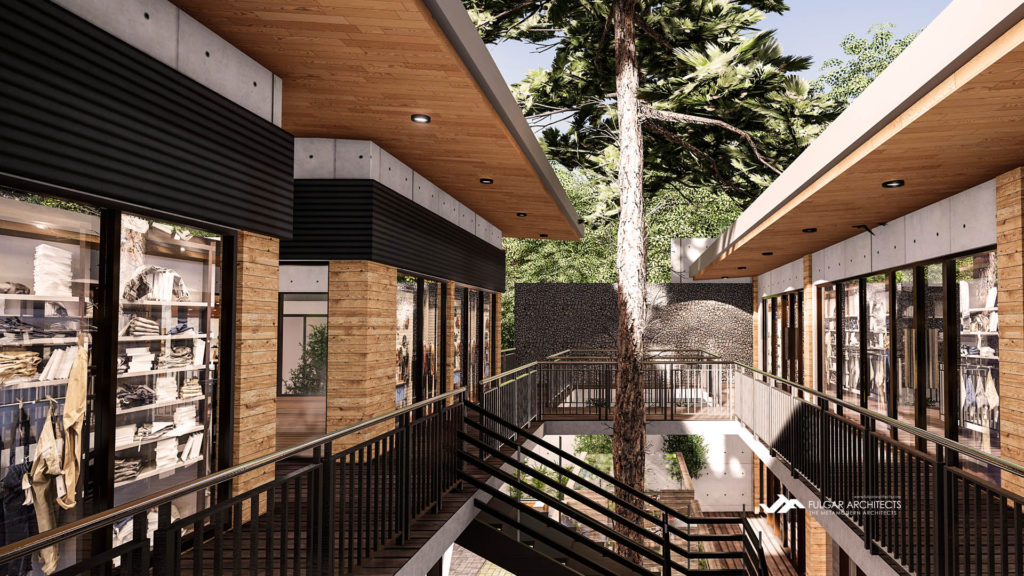
    Upper-level outdoor retail walkway with metal railings, full-height glass storefronts, timber soffit ceilings, exposed concrete wall panels, horizontal black corrugated metal cladding, and mature courtyard trees integrated into the building structure, set against lush green foliage.
    Our goal is to preserve the existing trees by creating an open-to-sky courtyard that is designed to work harmoniously with them. This approach enables us to preserve the natural beauty and ecological benefits of the trees while creating an inviting outdoor space for people to enjoy. The courtyard will be carefully planned to ensure that the trees remain a central feature, enhancing both the aesthetic and environmental quality of the area. By integrating the trees into the design, we create a serene atmosphere that encourages relaxation and connection with nature.

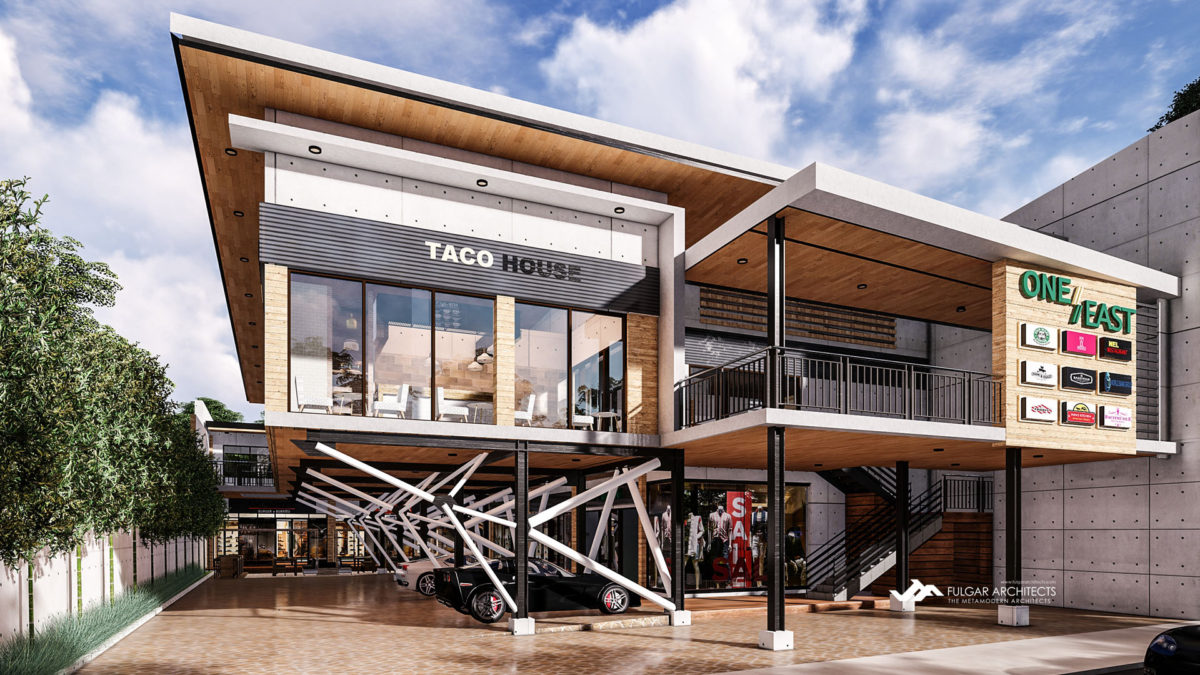
    Creating a new, attractive commercial center with its own business and social infrastructure, this two-story retail development comprises six rentable spaces, featuring a prominent frontage with diagonal brace frames. The project riffs on the idea of following the site’s natural orientation while maximizing its building envelope within an 892-sqm lot. Hence, the spatial configuration centered on a simple, straightforward floor plan with a large, central courtyard that integrated the site’s existing trees as part of its indoor landscape. Paired with its suspended walkways and a strong presence of wood, this allowed space to seamlessly blend with its foliage-filled vicinity.

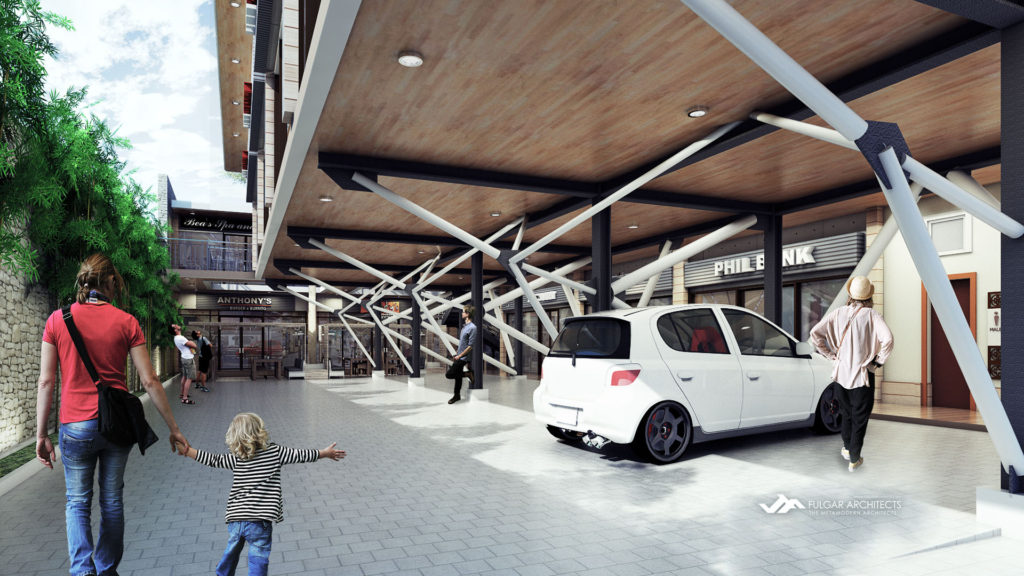
    Ground-level view of commercial walkway with exposed diagonal steel brace frames supporting the elevated structure, timber ceiling soffits, steel columns, modular light-colored pavement, parked vehicle, storefront glazing with retail signage, and planted green wall along the side boundary.
    Structural brace frames play a significant role in enhancing the architectural character of a building. These frames not only provide essential structural support and stability but also contribute to the overall aesthetic appeal. By integrating brace frames into the design, architects can create visually striking exteriors that reflect the uniqueness of the structure. This combination of functionality and artistic expression makes structural brace frames a valuable element in modern architecture.

    At street level, the project is identified by a series of diagonal steel brace frames that support the cantilevered shops above. The application of straightforward planning principles brings visitors directly either to the staircase or the courtyard. Traversing its U-shaped staircase brings visitors into a linear passageway that envelopes the entrances of each retail unit on the second floor. At the eastern boundary, this passageway eventually connects to a foliage-filled seating space tucked at its west.

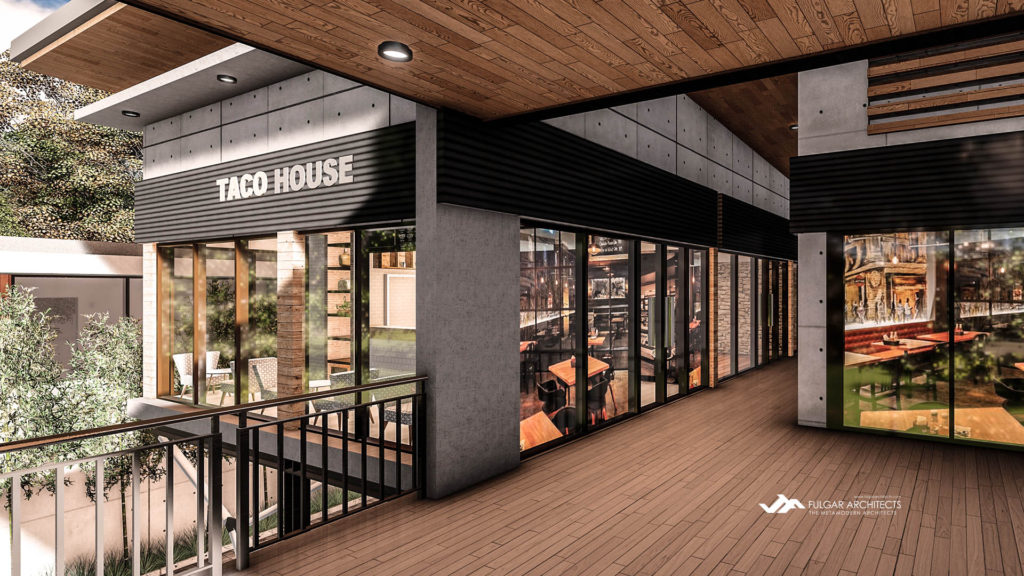
    Second-level outdoor retail corridor with full-height glass storefronts, exposed concrete columns, black corrugated metal cladding, timber plank ceiling soffits, warm wooden plank flooring, balcony railings, and visible interior dining and retail displays illuminated by natural daylight.
    The commercial hub has been thoughtfully designed to ensure an abundant supply of natural ventilation and daylight. This approach not only enhances the comfort of the occupants but also promotes energy efficiency and well-being. By incorporating strategically placed openings, the space allows fresh air to circulate freely while maximizing sunlight exposure, creating a bright and inviting environment for both work and relaxation.

    The ideal provision of natural light and fresh air in architectural design hinges on the harmonious integration of three essential elements. First, the site’s inherent characteristics contribute to its well-ventilated environment, capitalizing on local climate conditions and natural topography. This foundational aspect allows the building to maximize passive ventilation strategies, ensuring that air circulation is both efficient and effective. Second, the structure’s impressive elevation of 10 meters creates a dynamic relationship between the interior spaces and the surrounding environment. This height enhances the visual impact of the building, facilitating the movement of air and light, and allowing for unobstructed views and a greater sense of openness. High ceilings combined with expansive vertical spaces create a feeling of grandeur while promoting air circulation throughout the area.

    Lastly, the extensive use of glass in the building’s walls plays a crucial role in fostering a seamless connection between the indoors and outdoors. The glass façade allows for an abundance of natural light to penetrate deep into the interior, reducing the need for artificial lighting during the day and promoting energy efficiency.

    Additionally, large openings facilitate cross ventilation, which naturally cools the space and enhances occupant comfort. Together, these elements not only ensure that natural illumination and airflow pervade the interior but also elevate the overall aesthetic and functional qualities of the structure. The thoughtful integration of these design principles forms the core of the building’s construction, creating an environment that prioritizes both sustainability and the well-being of its inhabitants.

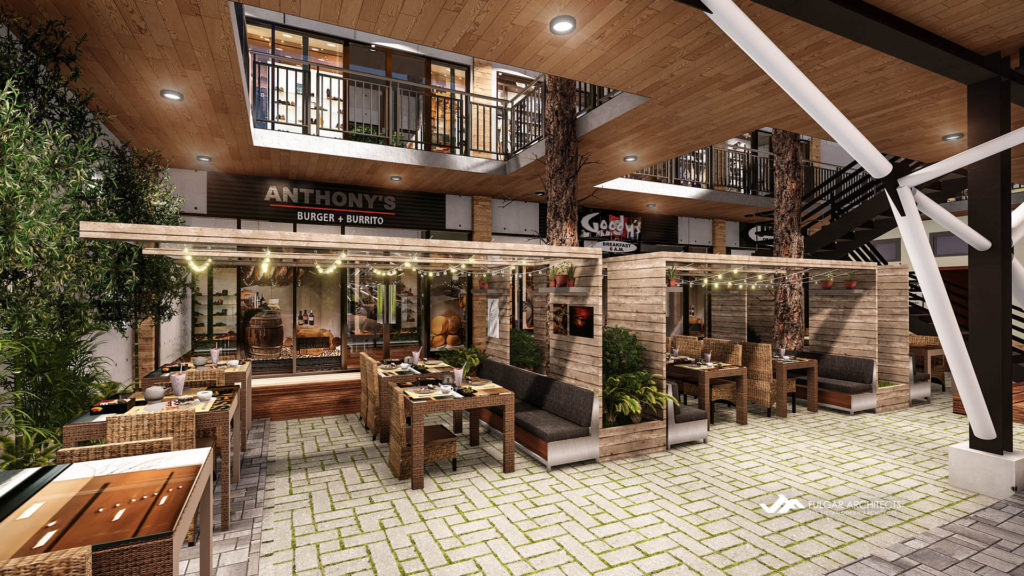
    Outdoor dining courtyard with semi-enclosed wooden booths, open tables with rattan chairs, string lighting overhead, permeable stone paver flooring with green grass joints, surrounding preserved trees integrated into the structure, and elevated steel walkways supported by diagonal brace frames.
    The alfresco dining area and meeting venue are situated in a quiet, secluded section of the development. This peaceful environment provides an ideal setting for guests to enjoy their meals or conduct meetings in a relaxed atmosphere, away from the hustle and bustle. Whether guests wish to savor delicious cuisine in the open air or engage in productive discussions, this venue offers an ideal blend of comfort and tranquility.

    Demarcating the project’s rectangular siting is a mixture of wooden claddings and exposed dark steel frames, highlighting the sharp contrast with the form’s lightly painted concrete plaster. This creates clear boundaries between the project’s parking and rentable spaces. To maintain such boundaries, the introduction of new visual elements is carefully planned. This ultimately framed the project to simultaneously become a background and an identifying form that matches both its exteriors and interiors.

    With a desire to blend seamlessly into the streetscape, One East Commercial Hub in Marikina City highlights the site’s existing natural features while maximizing both its architectural and practical characteristics. Wrapped in rectilinear forms with the unexpected touch of diagonal brace frames, this further props up the entire architectural character and structural integrity of the place while maintaining its original environmental identity.

    Feel free to share!