Project Tag: Shops

  • Shophouse and Townhomes in Lipa City

    Shophouse and Townhomes in Lipa City

    Situated in the elevated corridors of Lipa City, Batangas, this venture positions itself at the convergence of emerging suburban migration, entrepreneurial demand, and long-term asset growth outside Metro Manila. Its direct accessibility from the South Luzon Expressway places it within strategic reach of Metro Manila’s population while offering climate advantages, cleaner air, and lifestyle-oriented urban escape. Key institutional anchors, such as De La Salle Lipa, SM City Lipa, and Mount Malarayat Golf and Country Club, amplify the site’s locational advantage. At the same time, future infrastructure expansion fortifies long-term capital resilience for participants.

    Location: Lipa City, Batangas, Philippines
    Land Size: Approximately 6,000 square meters
    Project Type: Suburban Shophouse-Residential Equity Venture
    Current Stage: Proponent-led development framework; equity capital engagement ongoing
    Projected Value: Estimated consolidated real estate asset value between PHP 250 million and PHP 300 million upon complete execution

    Street-level view of modern two-storey shophouse units with ground floor commercial spaces including a barber shop and coffee shop, featuring wide carports, textured facade treatments, and landscaped foreground
    This frontage perspective illustrates the commercial adaptability embedded within the Lipa Shophouses and Townhomes development model. The lower levels are configured to support income-generating micro-enterprises, such as cafes, specialty retail, or personal services. In contrast, the upper residential levels maintain privacy and domestic comfort for the occupants. This configuration activates the frontage with foot traffic appeal, while still respecting suburban scale and architectural coherence. The contemporary facade treatment combines textured concrete panels, linear wood-toned banding, and minimalist light fixtures that elevate both design value and market appeal. This hybrid typology enables real estate investors to generate multiple revenue streams from a single property, while diversifying community offerings for both residents and local consumers.

    End-User Lifestyle Proposition

    This residential enclave integrates suburban living with entrepreneurial flexibility. Each home is designed with modern households in mind, balancing private family spaces with embedded work-from-home functionality, commercial conversion opportunities, and organic income-generating add-ons. Elevated terrain offers year-round advantages in a cool climate. Residents benefit from nearby schools, healthcare facilities, leisure activities, and commercial conveniences, thereby minimizing urban dependency and enhancing their daily quality of life. The master plan emphasizes walkability, security, and green spaces that cater to multi-generational residents, retirees, entrepreneurs, and returning Overseas Filipino Workers (OFWs) and their families.
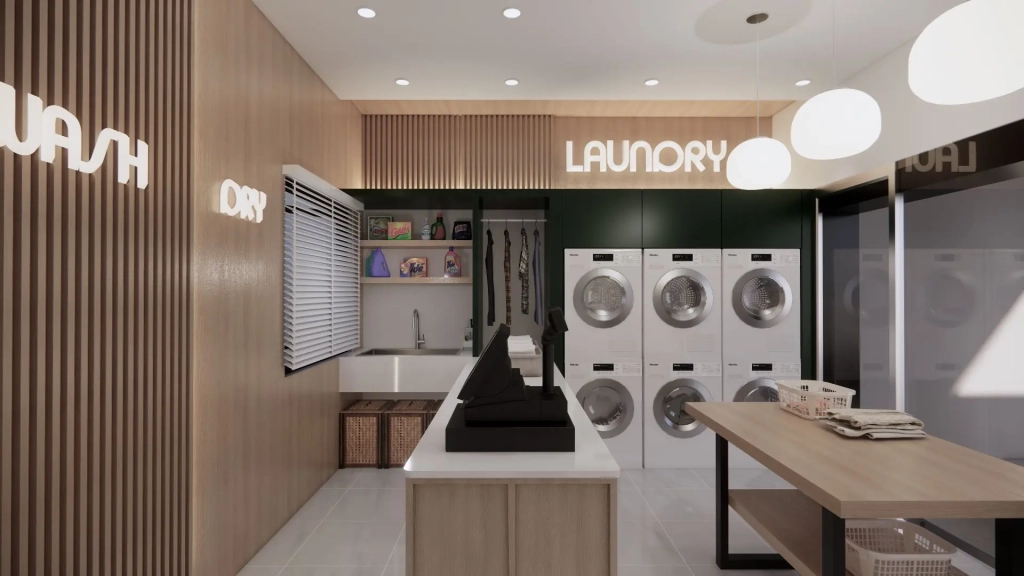
    Modern interior view of a laundry shop with wood-accented walls, cash register counter, built-in washing and drying machines, folding table, pendant lighting, and functional storage shelves
    A highly marketable micro-enterprise interior model embedded within the shophouse product stream for Lipa City’s growing suburban corridor. The laundry shop format exemplifies the venture’s income-generating adaptability, offering buyers and investors access to stable cashflow businesses directly tied to residential density. The clean, contemporary design features a balanced mix of commercial-grade equipment, organized storage, and inviting finishes that appeal to both neighborhood residents and external customers. Materials are curated for durability, ease of maintenance, and efficient spatial workflows, ensuring that business operators maintain smooth day-to-day operations while maximizing service turnover. This retail typology represents the scalable plug-in nature of the development’s commercial layer, allowing venture participants to access recurring business yield while anchoring foot traffic for the broader community.

    Market Rationale

    As Metro Manila continues to experience congestion saturation, provincial growth corridors like Lipa City attract both end-users and investors. The rising preference for suburban work-live models aligns with expanding infrastructure, regional employment hubs, and a renewed interest in OFW resettlement behavior. This venture captures that transition point, offering diversified unit types that serve both residential security and entrepreneurial ambitions through embedded commercial use options, small business capability, and income-generating flexibility within a master-planned community framework.
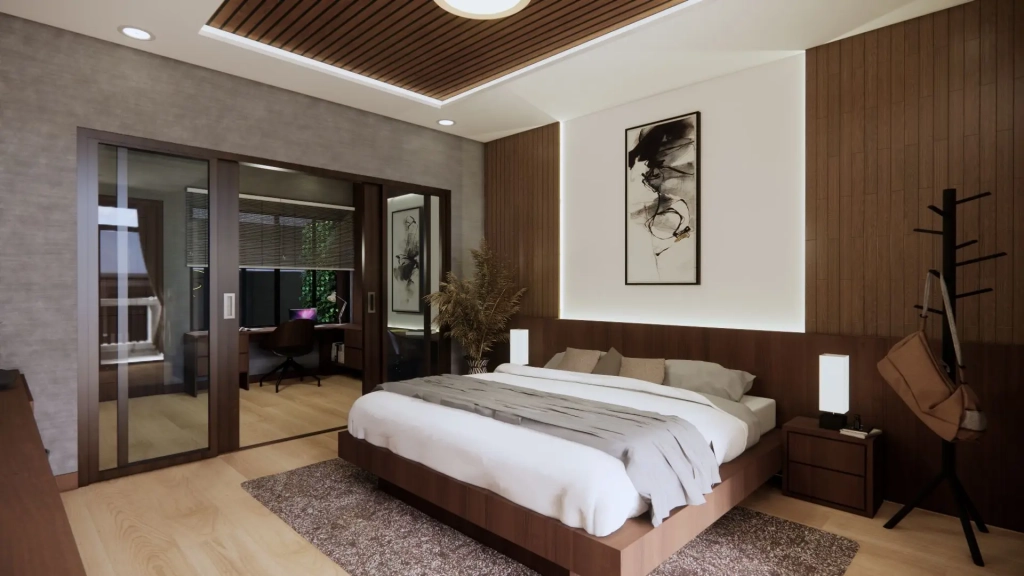
    Modern bedroom suite featuring a king-sized bed, wood-accented walls, ambient recessed lighting, ceiling slat treatments, glass sliding doors leading to an integrated home office workspace, and minimalist decor elements
    The proposed residential experience is showcased within the exclusive townhome units of the venture development in Lipa City, Batangas. The bedroom suite is configured for both personal retreat and functional productivity, featuring a dedicated home office enclave seamlessly integrated behind sliding glass partitions. The material palette balances warm wood textures with neutral surfaces, fostering an atmosphere of understated luxury appealing to both end-user buyers and discerning property investors. Design details such as recessed cove lighting, acoustic ceiling slats, and bespoke furniture placement contribute to long-term asset value by enhancing spatial efficiency and lifestyle adaptability. This residential typology directly supports higher price segmentation, positioning the exclusive units for market absorption among upwardly mobile families and OFW returnees seeking both comfort and investment security.

    Development Program

    The venture introduces three residential-commercial product streams:

    • Shophomes (6 units): Two-storey micro-enterprise dwellings blending residential living above with customizable commercial space below. Lot sizes range from 90 to 109 sqm, with a Gross Floor Area (GFA) of up to 78.5 sqm, allowing for the integration of compact homes and businesses.
    • Standard Homes (11 units): Mid-sized family townhomes ranging from 80 to 120 sqm lot areas, offering three to four bedrooms, open layouts, home-office adaptability, balconies, and garden spaces for growing households.
    • Exclusive Homes (28 units): Larger two-storey configurations from 100 to 150 sqm lots. Units feature convertible dens, Airbnb potential, vertical farming space, and micro-business expansion zones. GFA reaches up to 219 sqm to support entrepreneurial versatility.

    The master plan incorporates wide road frontages, controlled commercialization of frontage areas, community areas, and flexible site engineering to maintain a low-density appeal while maximizing usability for both residential living and income-supportive activities.

    Venture Structure

    The venture operates under a Proponent-Led Joint Venture Equity Model:

    • The landowner contributes property to the venture through sale, staged acquisition, or land value conversion, forming part of the project’s total development capitalization.
    • The land parcel becomes an integrated inventory that will be subdivided, developed, and sold as part of the venture’s deliverables.
    • In return, landowners receive a predetermined share of the development earnings or proceeds, as agreed upon.
    • The proponent maintains full governance, master planning, financial oversight, and operational execution.
    • All capital participants enter under structured development participation, whether through anchor equity, co-investment tranches, or inventory participation.
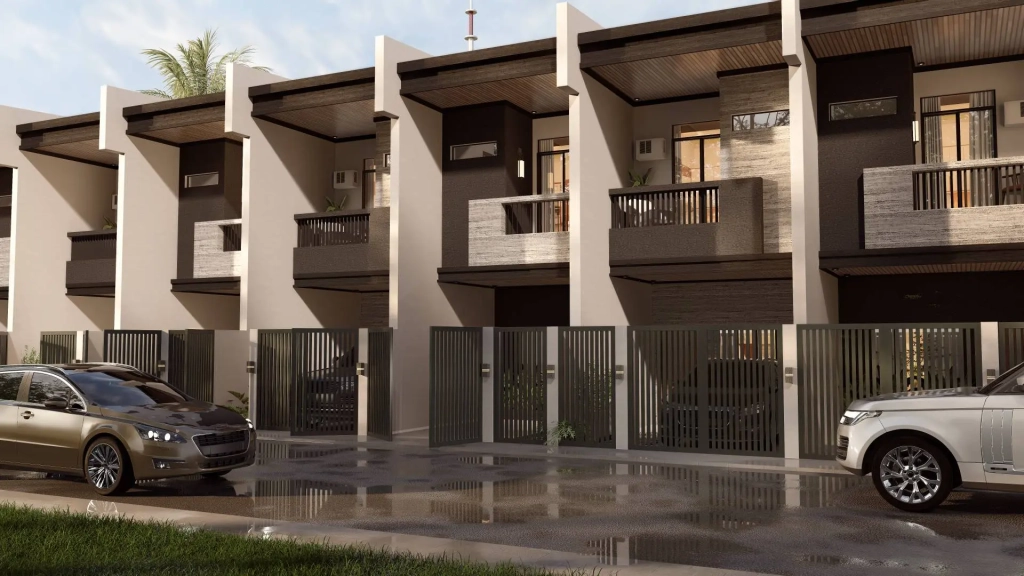
    Facade view of two-storey exclusive townhouses with cantilevered balconies, vertical slatted metal fences, wood-textured cladding, private carports, and modern architectural details
    The exclusive townhouse product line introduces a higher-value segment into the Shophouse and Townhomes development in Lipa City, Batangas. Designed to serve growing families and entrepreneurial households, these larger lot configurations integrate flexible living arrangements with passive income capabilities. The gated frontage provides secured carports while preserving marketable curb appeal, allowing buyers to maintain private residential sanctuaries alongside potential home-based business functions. Architectural materials emphasize longevity, low-maintenance performance, and elevated design distinction through textured claddings, recessed balcony volumes, and balanced fenestration. These units support a higher mortgage qualification range by enabling dual-income dynamics, positioning buyers to leverage both personal occupancy and auxiliary rental or business yield as part of long-term real estate value growth.

    Financial Outlook

    The whole development phase is projected to generate consolidated real estate assets valued at approximately PHP 250 million to PHP 300 million. Targeted profit range between 30% and 35%, governed by phased fund deployment and sales absorption velocity.

    Alignment Invitation

    This shophomes and townhouses venture serves as a regional prototype for suburban-integrated equity developments, merging stable residential end-user demand with embedded entrepreneurial flexibility. Aligned buyers, land partners, and institutional capital participants are invited to participate under the platform’s equity-governed architecture, preserving project integrity while sharing in sustainable, scalable venture growth anchored on real estate legacy creation.

    For Landowners

    Not sure what to do with your property? Let’s explore what your site could become.

    For Investors

    Looking for credible real estate ventures? We welcome your presence into our pipeline.

  • Streamlined Retail Design With Gas Station

    Streamlined Retail Design With Gas Station

    Positioned within the thriving economic corridor of Laguna, the Calamba Commercial Center emerges as a purposeful articulation of streamlined retail design, responding to the region’s dynamic growth and increasing demand for mixed-use developments. Occupying a site area of approximately 5,957 square meters, the development asserts a deliberate geometry that capitalizes on the site’s wide frontage and irregular boundaries. The composition transforms the parcel into a multi-layered commercial destination that accommodates both vehicular and pedestrian activity, integrating diverse retail experiences and essential fueling services within a cohesive architectural framework.

    Project Name: Calamba Commercial Complex
    Location: Calamba City, Laguna
    Site Area: 5,597 sqm
    Type: Commercial

    The architectural strategy revolves around the discipline of streamlined retail design. Instead of succumbing to the clutter often seen in multi-tenant complexes, the composition applies a disciplined rectilinear massing, centrally positioned within the site to maximize openness and visibility. This allows an intuitive flow for both vehicle circulation and pedestrian navigation across the entire property. With a unified plan that brings clarity to leasing parcels, tenants benefit from high visibility, direct accessibility, and balanced exposure throughout the property.

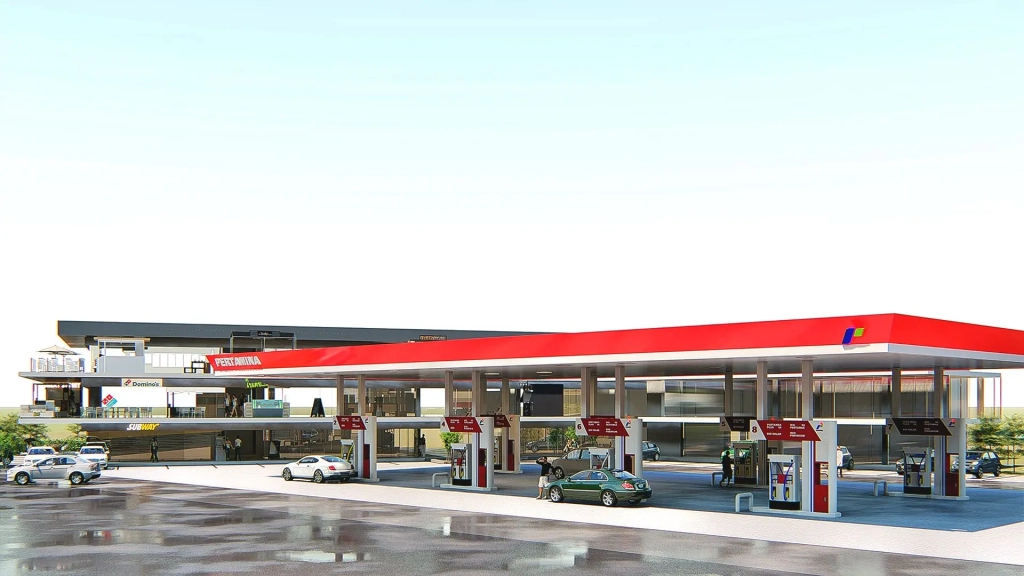
    Gas station with wide red canopy, multiple fueling bays, flat-roof retail building behind with three commercial levels, transparent glass facades, parking spaces, and vehicle circulation paths in Calamba City, Philippines.
    This commercial complex, which includes a gas station, plays a significant role in enhancing the property’s value for lot owners. Gas stations serve as essential amenities, providing convenience for motorists and attracting steady foot traffic to the complex. This influx of customers not only benefits the gas station but also draws attention to other businesses within the commercial space, ultimately leading to increased sales and higher rental income for lot owners. Furthermore, the development is more appealing to potential tenants and investors, enhancing the long-term viability and profitability of the commercial project.

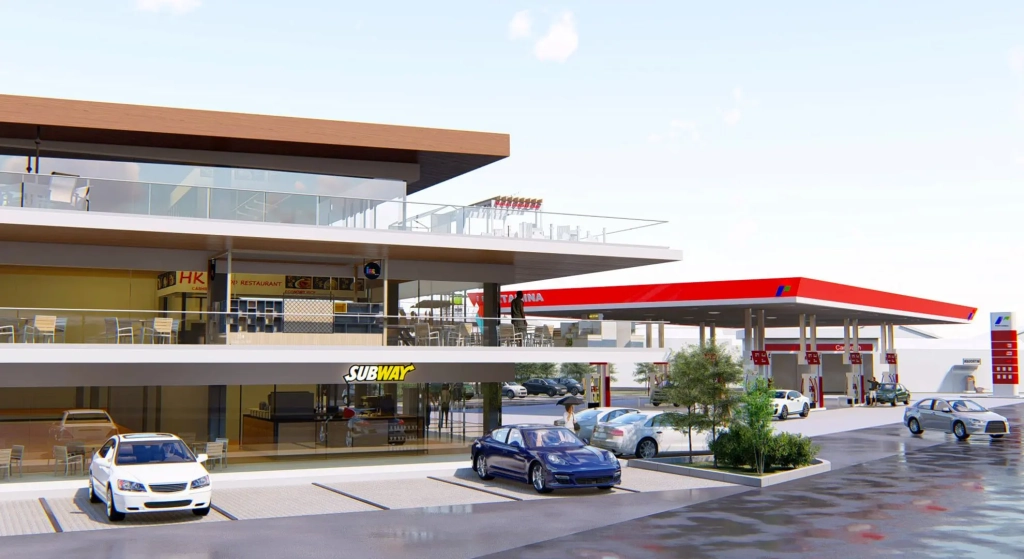
    Anchoring the project is a distinct three-story commercial complex that rises prominently at the center of the site, floating with wide setbacks that create generous forecourts and circulation zones. The structure’s strong horizontal articulation is expressed through expansive terraces, cantilevered floor plates, and minimalist slab projections. Wide driveways, ample parking bays, and open-air walkways frame the perimeter, allowing for unimpeded vehicular and pedestrian movement. Transparent glass facades establish continuous visibility across all levels, showcasing merchandise, dining activities, and tenant branding to both ground-level patrons and passing vehicles. Elevated dining decks and rooftop terraces further enhance the lifestyle offering, transforming upper floors into destination experiences within the streamlined retail design framework.

    A dedicated gasoline station is strategically positioned adjacent to the commercial structure, serving as a complementary activation point. Rather than existing as a separate facility, its proximity draws vehicular traffic that organically feeds into the retail circulation, enhancing cross-traffic between fueling, shopping, and dining activities. This adjacency strengthens the site’s commercial ecosystem, establishing the property as a complete roadside and neighborhood destination.

    Drive-thru retail complex with elevated terraces, large glass facades, transparent guardrails, covered vehicular access, landscape pockets, pedestrians, commercial signage, and clear circulation paths in Calamba City, Philippines.
    The exterior perspective of the Cruz Calamba Commercial building features a modern architectural design that combines functionality with visual appeal. Its striking facade, characterized by geometric shapes and large glass windows, allows for abundant natural light and transparency. Sustainable materials enhance durability while minimizing their environmental footprint. The inviting entrance, complemented by landscaping and wide walkways, encourages accessibility, and strategically placed signage ensures visibility for the businesses within. Overall, the building serves as a vibrant hub for commerce and community interaction, showcasing modern design principles.

    A key consideration in the streamlined retail design of Calamba Commercial Center is its allocation of twenty-two leasable spaces. These units support a diverse tenancy profile ranging from fashion boutiques to cafes, casual dining, and essential service providers. This tenant mix reflects modern consumer patterns where dining, daily essentials, and lifestyle services command more substantial foot traffic than traditional anchor-dependent models.

    Circulation design emphasizes openness without sacrificing organization. Multiple vehicular entry points eliminate the need for complicated traffic loops. Wide circulation aisles and clearly designated parking bays accommodate both private cars and delivery access. Pedestrian movement is guided by covered walkways that maintain comfort under varying weather conditions, enhancing dwell time and encouraging exploration across the site.

    Architecturally, the center’s minimalist aesthetic resonates with the discipline of streamlined retail design. The facades display a deliberate avoidance of ornamentation, focusing instead on proportion, material honesty, and functional expression. The use of glass, neutral cladding, and subtle steel detailing contributes to a contemporary commercial identity that is sophisticated yet inviting.

    Three-level commercial building with adjacent gas station, multiple fueling bays, elevated terraces, glass storefronts, outdoor dining areas, landscaped parking, and accessible retail circulation in Calamba City, Philippines.
    The gasoline station serves as a pivotal hub for travelers seeking convenient stopovers, elegantly complemented by a collection of leasable retail shops that foster a vibrant and diverse tenant mix. This carefully curated selection includes a range of fashion boutiques, inviting cafes, casual dining establishments, and essential service providers, all designed to enhance the overall experience for patrons. By embracing contemporary consumer trends, the design prioritizes accessibility and interaction, recognizing that amenities such as dining options, daily necessities, and lifestyle services drive foot traffic far more effectively than traditional anchor-dependent models.

    The master planning and design logic applied to Calamba Commercial Center represents an evolved approach to suburban commercial development. In an urbanizing node where real estate pressures demand both density and function, streamlined retail design provides the optimal response, balancing simplicity, commercial viability, and operational ease. This design vocabulary enables long-term adaptability, ensuring the property can maintain its relevance as tenant profiles evolve and consumer behaviors change.

    Upon its completion, the commercial center embodies the core principle that streamlined retail design is not merely an aesthetic choice but a strategic business approach. The clarity of form, efficiency of circulation, seamless integration of the gas station, and versatility of tenancy all contribute to a development that serves as both an investment instrument and a community anchor in the growing landscape of Laguna.

    Feel free to share!
  • One East Commercial Hub

    One East Commercial Hub

    The cleverly designed structural brace frames elevate the hovering commercial hub above the ground, creating an innovative architectural solution that promotes natural airflow throughout the space. This thoughtful elevation allows for the seamless flow of air, which is directed toward an inviting open-air southern courtyard. This courtyard serves as a vibrant outdoor dining area at ground level, providing patrons with a unique dining experience in a natural setting. It is beautifully enhanced by the presence of existing trees, which offer shade and greenery, contributing to a relaxed atmosphere. Additionally, the courtyard is flanked by community shops, fostering a sense of connection and engagement among both visitors and residents. This layout fosters a lively and interactive environment that seamlessly integrates nature and commerce.

    Location: #1 General Ordoñez Street, Marikina Heights, Marikina City
    Site Area: 892 sqm
    Project Area: 1,200 sqm
    Type: Commercial

    An adaptive architectural intervention that promotes new urban life, based on a mixture of modern and industrial structures and the contrast between new and existing solutions. One East Commercial Hub in Marikina City proposes an urban solution while retaining the environmental memory of the place.

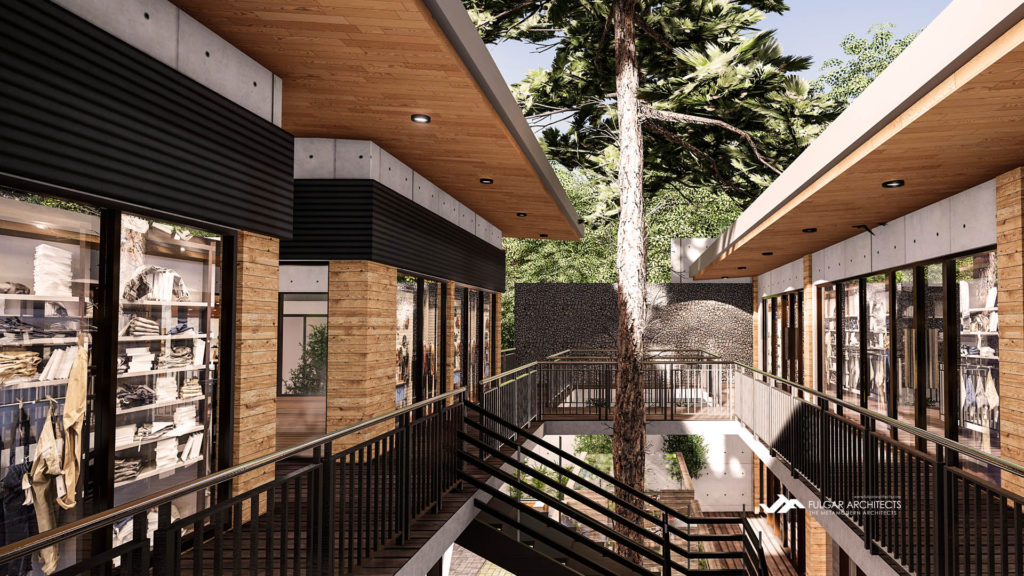
    Upper-level outdoor retail walkway with metal railings, full-height glass storefronts, timber soffit ceilings, exposed concrete wall panels, horizontal black corrugated metal cladding, and mature courtyard trees integrated into the building structure, set against lush green foliage.
    Our goal is to preserve the existing trees by creating an open-to-sky courtyard that is designed to work harmoniously with them. This approach enables us to preserve the natural beauty and ecological benefits of the trees while creating an inviting outdoor space for people to enjoy. The courtyard will be carefully planned to ensure that the trees remain a central feature, enhancing both the aesthetic and environmental quality of the area. By integrating the trees into the design, we create a serene atmosphere that encourages relaxation and connection with nature.

    Creating a new, attractive commercial center with its own business and social infrastructure, this two-story retail development comprises six rentable spaces, featuring a prominent frontage with diagonal brace frames. The project riffs on the idea of following the site’s natural orientation while maximizing its building envelope within an 892-sqm lot. Hence, the spatial configuration centered on a simple, straightforward floor plan with a large, central courtyard that integrated the site’s existing trees as part of its indoor landscape. Paired with its suspended walkways and a strong presence of wood, this allowed space to seamlessly blend with its foliage-filled vicinity.

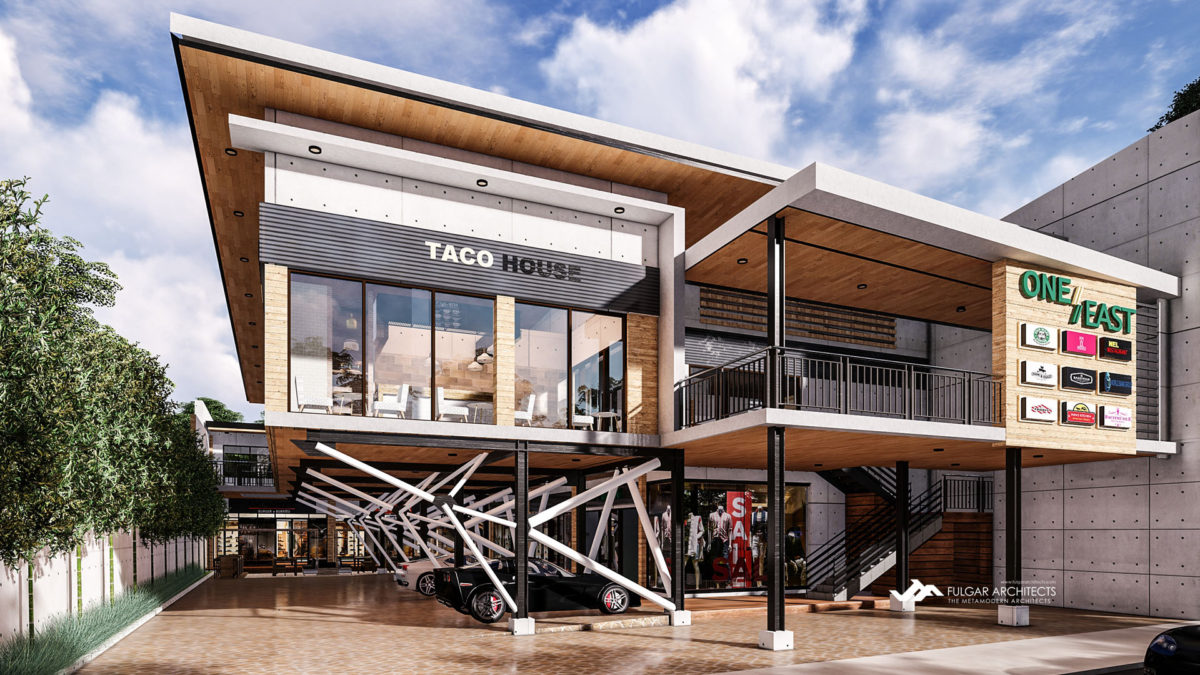
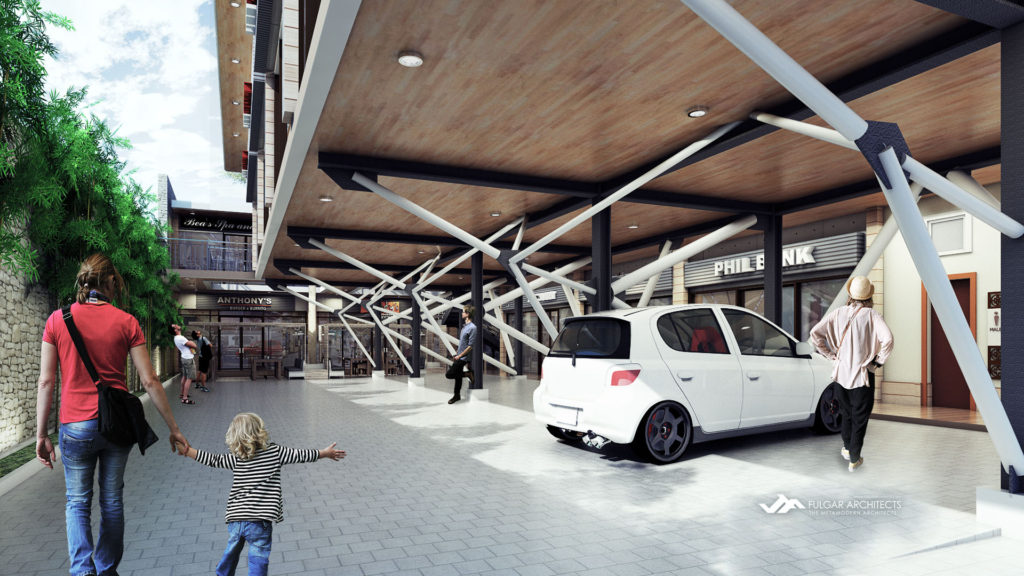
    Ground-level view of commercial walkway with exposed diagonal steel brace frames supporting the elevated structure, timber ceiling soffits, steel columns, modular light-colored pavement, parked vehicle, storefront glazing with retail signage, and planted green wall along the side boundary.
    Structural brace frames play a significant role in enhancing the architectural character of a building. These frames not only provide essential structural support and stability but also contribute to the overall aesthetic appeal. By integrating brace frames into the design, architects can create visually striking exteriors that reflect the uniqueness of the structure. This combination of functionality and artistic expression makes structural brace frames a valuable element in modern architecture.

    At street level, the project is identified by a series of diagonal steel brace frames that support the cantilevered shops above. The application of straightforward planning principles brings visitors directly either to the staircase or the courtyard. Traversing its U-shaped staircase brings visitors into a linear passageway that envelopes the entrances of each retail unit on the second floor. At the eastern boundary, this passageway eventually connects to a foliage-filled seating space tucked at its west.

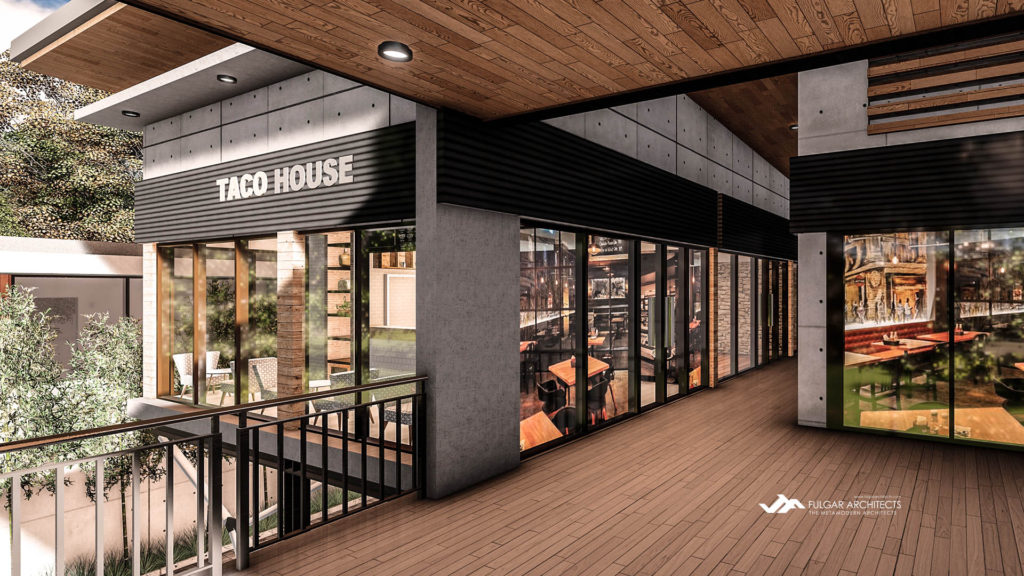
    Second-level outdoor retail corridor with full-height glass storefronts, exposed concrete columns, black corrugated metal cladding, timber plank ceiling soffits, warm wooden plank flooring, balcony railings, and visible interior dining and retail displays illuminated by natural daylight.
    The commercial hub has been thoughtfully designed to ensure an abundant supply of natural ventilation and daylight. This approach not only enhances the comfort of the occupants but also promotes energy efficiency and well-being. By incorporating strategically placed openings, the space allows fresh air to circulate freely while maximizing sunlight exposure, creating a bright and inviting environment for both work and relaxation.

    The ideal provision of natural light and fresh air in architectural design hinges on the harmonious integration of three essential elements. First, the site’s inherent characteristics contribute to its well-ventilated environment, capitalizing on local climate conditions and natural topography. This foundational aspect allows the building to maximize passive ventilation strategies, ensuring that air circulation is both efficient and effective. Second, the structure’s impressive elevation of 10 meters creates a dynamic relationship between the interior spaces and the surrounding environment. This height enhances the visual impact of the building, facilitating the movement of air and light, and allowing for unobstructed views and a greater sense of openness. High ceilings combined with expansive vertical spaces create a feeling of grandeur while promoting air circulation throughout the area.

    Lastly, the extensive use of glass in the building’s walls plays a crucial role in fostering a seamless connection between the indoors and outdoors. The glass façade allows for an abundance of natural light to penetrate deep into the interior, reducing the need for artificial lighting during the day and promoting energy efficiency.

    Additionally, large openings facilitate cross ventilation, which naturally cools the space and enhances occupant comfort. Together, these elements not only ensure that natural illumination and airflow pervade the interior but also elevate the overall aesthetic and functional qualities of the structure. The thoughtful integration of these design principles forms the core of the building’s construction, creating an environment that prioritizes both sustainability and the well-being of its inhabitants.

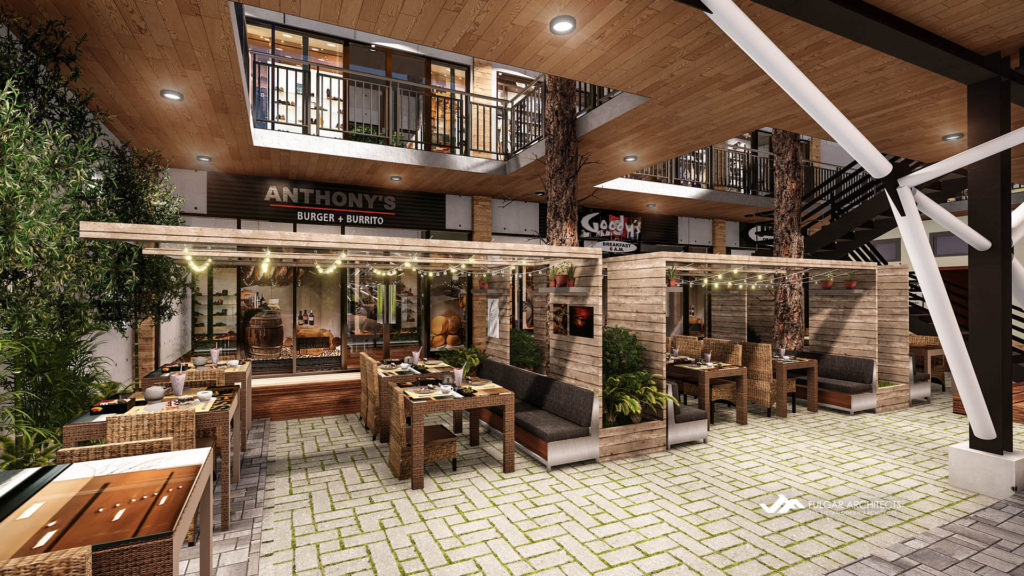
    Outdoor dining courtyard with semi-enclosed wooden booths, open tables with rattan chairs, string lighting overhead, permeable stone paver flooring with green grass joints, surrounding preserved trees integrated into the structure, and elevated steel walkways supported by diagonal brace frames.
    The alfresco dining area and meeting venue are situated in a quiet, secluded section of the development. This peaceful environment provides an ideal setting for guests to enjoy their meals or conduct meetings in a relaxed atmosphere, away from the hustle and bustle. Whether guests wish to savor delicious cuisine in the open air or engage in productive discussions, this venue offers an ideal blend of comfort and tranquility.

    Demarcating the project’s rectangular siting is a mixture of wooden claddings and exposed dark steel frames, highlighting the sharp contrast with the form’s lightly painted concrete plaster. This creates clear boundaries between the project’s parking and rentable spaces. To maintain such boundaries, the introduction of new visual elements is carefully planned. This ultimately framed the project to simultaneously become a background and an identifying form that matches both its exteriors and interiors.

    With a desire to blend seamlessly into the streetscape, One East Commercial Hub in Marikina City highlights the site’s existing natural features while maximizing both its architectural and practical characteristics. Wrapped in rectilinear forms with the unexpected touch of diagonal brace frames, this further props up the entire architectural character and structural integrity of the place while maintaining its original environmental identity.

    Feel free to share!