


Since the barangay is the most fundamental level of community in the Philippines, the legitimate and seamless process of integrating into the neighborhood will require the authorization of the barangay’s community leaders. This prerequisite includes getting barangay clearance for construction projects.
A barangay clearance, also known as a barangay permit, is the most straightforward paperwork to ensure that your activities are lawful and maintain community standards. In addition, you may get legal documentation and barangay clearance to access several government programs, including scholarships.
Nonetheless, most barangays also retain a much smaller community comprised of zones and exclusive subdivisions. Community leaders are responsible for authorizing the territories that come under their control. Hence, they will also require zone clearance to secure barangay approval.
According to the Implementing Rules and Regulations (IRR) of Republic Act No. 11032, or the Ease of Doing Business and Efficient Government Service Delivery Act of 2018, a barangay clearance refers to any document issued by a barangay, which can be either free or subject to corresponding fees. The rules state that the formal clearance is in their ordinances relative to or concerning the issuance of other documents. Among these documents are the business permit and the locational clearance the city or municipality granted.

Why do you need a Barangay Clearance For Construction?
The barangay clearance for construction purposes is not a specific requirement for the application for the building permit and the certificate of occupancy. However, the Office of the Building Official will require a barangay clearance for issuing a locational clearance, the latter being a requirement for the building permit and the certificate of occupancy.
For construction projects requiring a Barangay Clearance, the Department of Interior and Local Government (DILG) and the Local Government Unit (LGU) of each municipality offers a One-Stop-Shop for Construction Permitting (OSCP) meant to speed up the process of getting your construction forms.
The OSCP is only one of many mechanisms outlined in the Joint Memorandum Circular (JMC) between the DILG, the DPWH, the Department of Trade and Industry (DTI), and the Department of Information and Communications Technology (DICT). The technology aims to reduce bureaucratic red tape in obtaining a building permit and a certificate of occupancy.
What is the One-Stop Shop for Construction Permitting (OSCP)?
The OSCP’s functions are as follows:
1. To receive construction permit applications and records, as well as certificates of occupancy
2. To coordinate and assist the performance of technical evaluations by city or municipal agencies (e.g., Zoning Office, Barangay Official) and the local Bureau of Fire Protection (BFP)
3. To ease the recovery of document requirements such as the tax declaration and current receipt of real estate tax payments in collaboration with relevant city or municipal offices.
In conjunction with the BFP, the Zoning Officer, the Assessor’s Office, the Treasurer’s Office, and the OBO, the OSCP will also adopt a one-time assessment of fees linked to applications for building permits and certificates of occupancy. In addition, it will organize the performance of joint inspections by the OBO, the Assessor’s Office, and the BFP.
The system will accept payment of all applicable fees in collaboration with the BFP and the OBO and provide the building permit or certificate of occupancy, either electronically or physically.
The Prescribed Steps In Using OSCP
An applicant can complete two building construction processes through this one-stop shop: the application for a Building Permit and the Certificate of Occupancy.
Compared to the traditional process of applying for construction permits which generally takes around 122 days with 23 steps, the OSCP guarantees a 36-day processing time in 8 steps.
The following are the steps for securing several constructions permits the OSCP way:
Step 1: Get a true certified copy of the land title (2 days)
Step 2: Get building permits, ancillary permits, locational clearance, and FSEC (9 days)
Step 3: Apply for Certificate of Occupancy, tax deduction, FSaC, and Certificate of Final Electrical Inspection (CFEI) (1 day)
Step 4: Receive joint inspection from the Office of the Building Official (OBO), City Assessor’s Office, and the Bureau of Fire Protection (1 day)
Step 5: Pay fees and get a Certificate of Occupancy, FSIC, new tax declaration, CFEI, and Certificate of Machinery Operation for warehouses (7 days)
Step 6: Apply for water and sewage connection (1 day)
Step 7: Receive inspection for water and sewage connection (1 day)
Step 8: Get a water and sewage connection (14 days)
Steps For Building Permit or Certificate Of Occupancy
For applicants who are only after a building permit or a certificate of occupancy, there are only four steps to take note of:
Step 1: Submission of application forms and documentary requirements
Step 2: Receipt of the order of payment
Step 3: Payment of fees
Step 4: Claiming the Building Permit and the Certificate of Occupancy
Included in the benefits of the OSCP is the Barangay Clearance submission after the Building Permit issuance.
How should you pay for your Barangay Clearance?
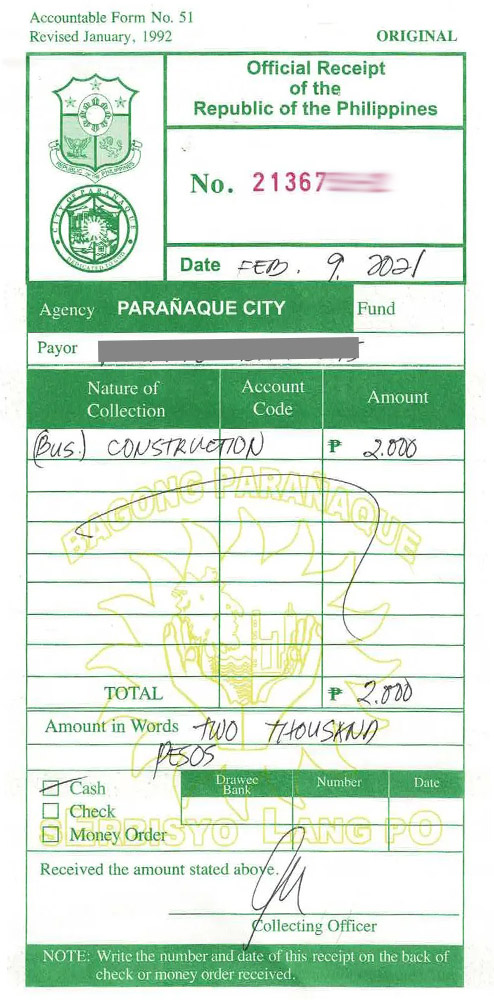
Payment for the Barangay Clearance shall be included in the Order of Payment (ToP) for the Building Permit, along with other authorized fees. The authorized City or Municipal Treasurer shall collect the payment and immediately issue an official receipt.
The following shows the official receipt of a barangay clearance for building construction as well as the barangay construction clearance itself:

How will you claim your Barangay Clearance?
The barangay clearance for construction is usually issued and submitted to the authorized Zoning Officer by the concerned barangay. The zoning officer then does the same and releases the locational clearance.
Completing The Process
The prerequisites for barangay clearance are straightforward. In addition, these criteria serve as evidence of identification and residency. However, sometimes, the bureaucracy’s culture or processing timeframe will challenge your patience and perseverance. With the advent of OSCPs, individuals no longer need to visit several offices to apply for and get business licenses and certificates of occupancy. Additionally, the OSCP will assist them in expediting the examination and releasing the necessary documentation. Before submitting, double-check the filled-out information to prevent confusion and certificate issues. When leaving the office, the applicant should also verify that the barangay has not made any mistakes on the certificate.

Leave a Reply