



If you are a property owner or real estate developer who is looking to be a part of the condominium buy-and-sell market, you have likely heard about the importance of getting your License to Sell from DHSUD. This license is common among those who are looking to enter into this market and will provide all of the necessary documentation that will allow for buying and selling of properties as one of the many aspects of your business.
Once the real estate project has been registered, a license to sell must be obtained before the subdivision lots or condominium units may be sold. Furthermore, the law provides for the suspension and revocation of registration and licenses in certain situations, as well as the procedure to be followed in such instances. Finally, administrative fines and other penalties are given in the case of a violation or non-compliance with the law’s provisions.
The License To Sell From DHSUD
A License to Sell, abbreviated as either LTS or LS, is a certification granted to a property developer by the Department of Human Settlements and Urban Development (DHSUD), which merges the former Housing and Land Use Regulatory Board (HLURB) and the Housing and Urban Development Coordinating Council (HUDCC). The registration and licensing of subdivision and condominium projects, agricultural lots, memorial parks, and columbaria are among the duties of this agency. They are also in charge of overseeing the design and building of registered/licensed projects. This ensures that the condominium complex is constructed in compliance with the Philippine National Building Code and its Implementing Rules and Regulations.
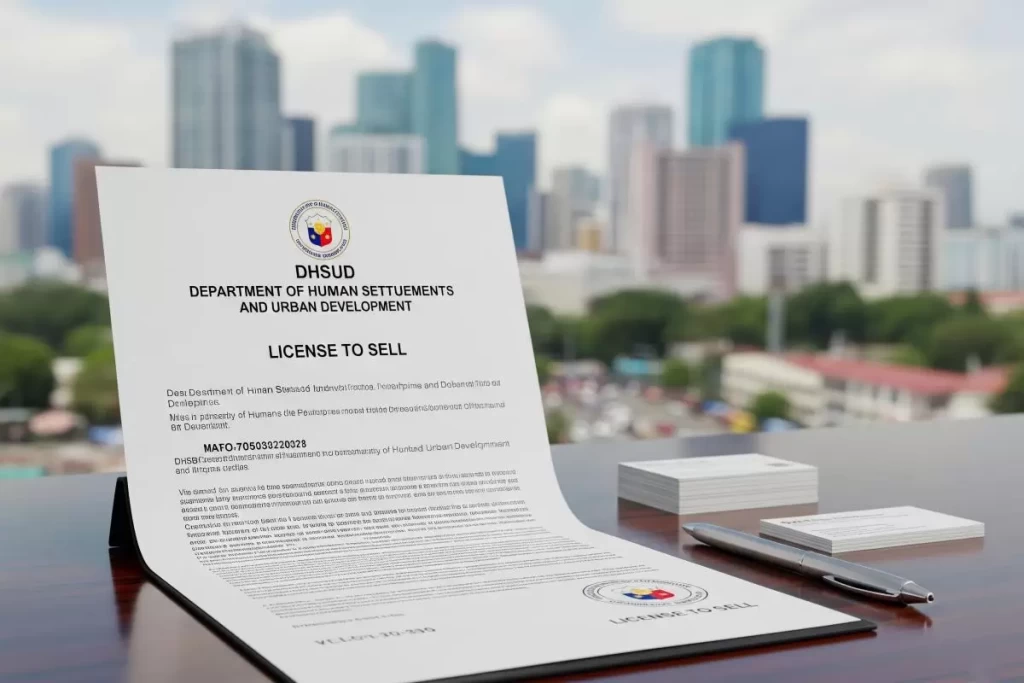
Along with the Certificate of Registration (CR), Presidential Decree (PD) No. 957 or the Subdivision and Condominium Buyer’s Protective Decree states that:
Such owner or dealer to whom has been issued a registration certificate shall not, however, be authorized to sell any subdivision lot or condominium unit in the registered project unless he shall have first obtained a license to sell the project within two weeks from the registration of such project.
Presidential Decree 957
Developers are not allowed to promote projects unless they have a sales license. That is why you will see disclaimers in their project presentations stating that they are solely provided for notification purposes.
Why Is It Necessary To Have A License to Sell?
The License to Sell is a legal document that allows a property owner or developer to sell their property or projects legally. This license demonstrates that the developer is capable of finishing the property or condominium project while complying with all relevant laws and regulations.
As a reminder, while it is the buyer’s responsibility to conduct due diligence on the seller with whom he or she is dealing, it is important for property owners and developers to also be aware that every seller’s License to Sell is only a verification step away from the nearest DHSUD Regional Office in a locality.
What Are The Application Requirements?
Given that property sellers must possess both a Certificate of Registration and a License to Sell, it’s logical that they have the same conditions. However, take into account that regulations may vary by typology. As a guide, the following documents are required when applying for a License to Sell for condominium projects:
- A copy of any circular, prospectus, brochures, advertisement, or communication used/to be used for the public offering of the subject project and circulation upon approval by the Department.
- Affidavit of Understanding to submit titles to the Department.
- Articles of Incorporation, By-laws, and latest annual corporate report to Securities and Exchange Commission (SEC)
- Building Permit
- Certified true copy of DAR Conversion Order / Exemption Clearance
- Certified true copy of Environmental Compliance Certificate (ECC) / Certificate of Non – Coverage (CNC)
- Certified True Copy of Transfer Certificate of Title (TCT) or Original Certificate of Title (OCT) duly stamped with original marking “Certified True Copy” by the proper Register of Deeds and bearing its seal or security marker.
- Duly accomplished and notarized fact sheet.
- Duly audited Balance Sheet
- Electrical Plan and Specifications
- Master Deed with Declaration of Registration and Declaration of Restrictions evidenced by the proper annotation thereof in the title(s) of the property and the certified true copy of such title(s) from the register of Deeds
- Permit to operate a deep well/ water potability test results
- Program of development (bar chart with S-curve, Gantt chart/ PERT-CPM, etc.) signed and sealed by a licensed engineer or architect indicating work activities, duration, and cost
- Project Study
- Sample copy of Contract to Sell
- Sworn Registration Statement
- Zoning Certificate from Department
Fees Involved With The Application
Despite the fact that the criteria for the Certificate of Registration and the License to Sell are similar, the requirements for the Certificate of Registration and the License to Sell are distinct. The following are the financial requirements for the License to Sell:
License To Sell Per Lot
Residential zones would cost 17.30 Philippine Peso (PHP) per square meter of the saleable area. While the commercial zone would cost 36.00 Philippine Peso (PHP) per square meter of the saleable area.
Inspection Fees
The inspection fee is normally charged at 1,500.00 Philippine Pesos (PHP) per hectare.
Cost Per Form
CRLS (Certificate of Registration / License to Sell) Form can be acquired for 432.00 Philippine Pesos (PHP).
When both the documentation and financial criteria are complete, they may be submitted to the Regional Office of the Department of Housing and Urban Development (DHSUD) in the corresponding locality.
How Long Does The Process Take?
It takes about twenty-one (21) business days or more than three (3) weeks to get your License to Sell, which is similar to the time it takes to obtain your Certificate of Registration. That is, assuming all of the necessary documentation and payment requirements are completed.
During this time period, the application will go through three (3) phases of processing. The first step, which takes place over the course of two (2) days, is primarily concerned with the submission of the required documentation and monetary contributions. Following this period, the application, requirements, the property itself, as well as the performance bond, will all be assessed and reviewed. Finally, the following one (1) day is when the applicant finally claims his/her License to Sell.
Benefits Of Keeping A License
Condominium properties are becoming more popular as people strive for urban living. It can be difficult for buyers and sellers to protect themselves from unscrupulous practices in the Philippines. One way to guarantee customers is to present a license to sell before any contracts are signed. This provides assurance that the condominium developer has complied with the authority and shows expertise in handling such transactions. It is important to protect not only the investments of the property buyer but also the integrity of the seller.


Leave a Reply to Jek Billones Cancel reply